
A favorite is the side the odds give the better chance of landing, and the underdog is the side with the smaller one. That's all the labels mean, and you don't need to know anything else about odds to read them. On September 7, 2024, Northern Illinois beat fifth-ranked Notre Dame 16-14 at Notre Dame Stadium, on a field goal in the final minute (Notre Dame Athletics). Notre Dame went on to reach the national title game that season, where it lost 34-23 to Ohio State (NCAA.com). The favorite was the better team, and it lost anyway.
The odds put a number on the label
The chance the odds give an outcome is called its implied probability. Anything above 50% is a favorite and anything below it is an underdog. The two sides of a pick always add up to 100%, so if the odds give one team a 70% chance to win, the other team gets 30%.
Read it like a weather forecast. A 70% chance of rain means that on days like this one, it rains about seven times in ten. The three dry days in ten don't make the forecast wrong, and a favorite that loses doesn't make the odds wrong either.
Implied probability is the odds' best estimate of the true chance, which nobody knows ahead of time. Your read matters when you think the true chance is different from that estimate.
The label also hides the size of the gap. A 55% favorite is close to a coin flip, while an 85% favorite loses about three games in twenty. Both get called the favorite, even though the second one is far more likely to come through. In GAGE the gap matters even more, because the chance sets your points. Every pick is worth 10 points, split by its chance of landing:
| Chance of landing | What it's called | If it lands | If it misses |
|---|---|---|---|
| 15% | Big underdog | +8.5 | −1.5 |
| 30% | Underdog | +7.0 | −3.0 |
| 45% | Slight underdog | +5.5 | −4.5 |
| 55% | Slight favorite | +4.5 | −5.5 |
| 70% | Favorite | +3.0 | −7.0 |
| 85% | Big favorite | +1.5 | −8.5 |
A 30% chance still comes in three times in ten
Baseball shows how often the better team loses. The Milwaukee Brewers had the best record in the majors in 2025 at 97-65, and they still lost four games in ten. The Colorado Rockies lost 119 games and still won 43 (MLB.com standings). In any one baseball game, the favorite losing is ordinary.
A single game gives a 30% chance plenty of room to land, while a full season gives the better team time to show it. That's why one upset tells you so little about either team, and why the habits that make your picks better start with sample size.
None of this makes the underdog the smart side by default. A 30% pick that lands 30% of the time averages zero in GAGE, the same as a favorite that lands as often as its chance says.
Your points come from the chance you lock
In GAGE, a pick with chance p scores 10 × (1 − p) when it lands and costs 10 × p when it misses. At 70% that's +3.0 or −7.0, and at 30% it's +7.0 or −3.0.
Now pick the favorite at 70% in ten games. If it wins seven, you score 7 × 3 = +21 and lose 3 × 7 = −21, which leaves you at zero. Take the underdog at 30% in the same ten games and you land in the same place from the other side, with three wins at +7 and seven losses at −3. Picking everything the way the odds do averages zero, whichever side you like.
Your score climbs only when your read of the chance beats the one you locked. Say you think an underdog the odds have at 30% really wins about 40% of the time. Over enough picks like that, you'd average a point a pick: 0.4 × 7 − 0.6 × 3 = +1.0. Across a whole game, GAGE adds it up for you, and your score is 10 × (picks right − the number of picks the odds expected you to get right).
Lock in before the odds move
The odds keep moving until the game starts, and news moves them most, like a starting quarterback being ruled out. When you make a pick in GAGE, the odds you got are locked to that pick, whatever the card shows afterward.
Say you make a Team Pick'em pick on an underdog early in the week, at 30%. Before the slate's first kickoff, the favorite's starting quarterback is ruled out, and the underdog's chance climbs to 45%. Your pick keeps its 30%, so it scores +7.0 if the underdog wins and costs 3.0 if it doesn't. A friend who makes the same pick after the news gets +5.5 or −4.5.
You can edit Team Pick'em picks until the slate's first kickoff. A pick you leave alone keeps the odds from its first lock. Change its side or line, or drop it and add it back, and it takes the odds at that moment. Once the slate kicks off, every pick is locked for good.
The same rule applies when the news goes against you: switch sides before the deadline and the new pick takes the new odds. The odds page has the full rules on scoring and lock-in.
Ask why the favorite is favored
Two favorites at the same chance can be favored for very different reasons. One has a healthy starting quarterback and an offense that keeps moving the ball, which you can check with EPA per play. Another has a shiny record built on close wins, the kind that tends to slide back. The 2022 Vikings went 13-4 while scoring 424 points and allowing 427 (NFL.com standings), then went 7-10 the next season (NFL.com).
Where the game is played matters too. A team can be the underdog on the road and the favorite at home against the same opponent a few weeks later, with nothing about either roster changed. Check the setting before you decide how much the label is worth.
Before you take a side, ask what would have to go right for the underdog. If the honest answer is a string of lucky breaks, the favorite has probably earned its chance. If it's something the underdog already does well, like pressuring the quarterback, the gap may be smaller than the card says, and the underdog's points start to look good.
Player picks have a favorite side too
Here's a real GAGE card: Christian Watson, receiving yards 70+, with YES worth 5.4 points and NO worth 4.6. Working back from the points, the odds gave YES a 46% chance and NO a 54% chance, so NO was the favorite by a hair.
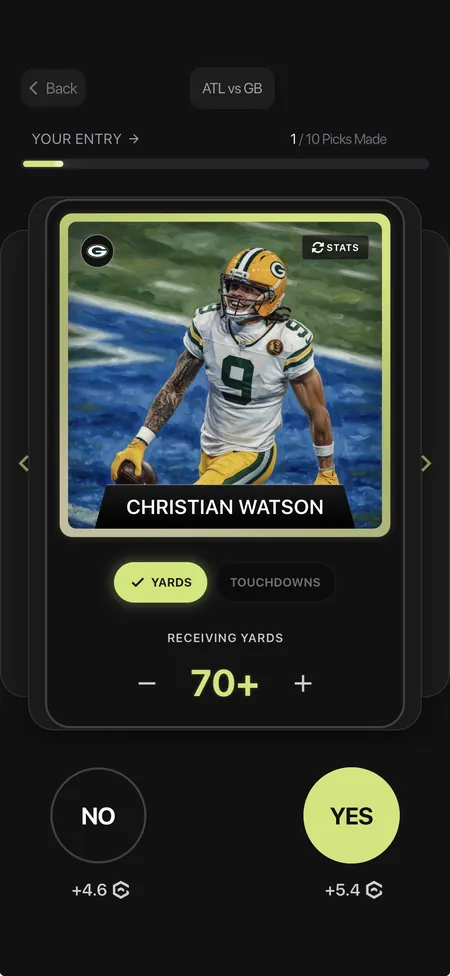
If you'd read the matchup and figured he'd get to 70 more often than not, YES was an underdog worth taking. The guide to reading an NFL player's week covers what to look at before a pick like that.
Make your read, then check the card
Guess the chance before you look, even if it's rough, then see where the odds landed. Write the guess down, since it's easy to remember it as closer to the card than it was. Do it every week and you'll learn which favorites you trust too much and which underdogs you keep writing off.
GAGE is built around that habit. Every pick you make locks the odds you got, and your score shows whether your reads beat them. GAGE is on the App Store if you want to try it on this week's games.