
A receiver's yards start with how often the ball comes his way. Everything else in a receiving-yards pick sits on top of that number, and last week's box score is a shaky way to guess it. His job this week is a better guide, and most of it is public before kickoff.
Start with his share of the ball
Two usage numbers get mixed up all the time. Snap share is how much of the game a player is on the field for, as a percent of his team's offensive plays. Target share counts something else: the percent of his team's passes thrown his way. A blocking tight end can play almost every snap and see two passes, while a slot receiver who only comes in on passing downs can lead the team in targets.
For a receiving-yards pick, targets come first, since his yards can only come from passes thrown to him. A share also depends on the team's total: a quarter of 25 passes is about 6 targets, and a quarter of 45 is 11. If you can find route participation, the share of pass plays where he runs a route, it sits between snaps and targets and tells you how much of his playing time is real pass-game work.
For a rushing-yards pick, start with carries, then use snap share to see whether he's the back they trust on every down or the one who comes in on third down. Snap share earns its keep as an early warning: when a player's snaps slide for a couple of weeks, his role is usually shrinking before the box score shows it.
For scale, Ja'Marr Chase led the NFL with 1,708 receiving yards in 2024 on 175 targets, according to NFL.com's receiving leaders, and his game log shows he played all 17 games. That's about 10 targets a game for the most productive receiver in the league. Most players you'll pick see fewer, so one drop or one broken tackle can swing their whole line.
Touchdown picks need one more check. The player who leads his team in targets isn't always the one they look for near the goal line, and a short-yardage back can take the rushing score from the lead back. Before an anytime TD pick, look at who's gotten the ball inside the 10 over the last few weeks.
| Before kickoff, ask | Where to look | What it changes |
|---|---|---|
| Is he on the field? | His snap share over the last few games | Whether his role is steady enough to trust |
| Does the ball find him? | Targets per game and his share of team passes | Receiving-yards picks |
| Who gets the carries? | Carries per game and who plays on third down | Rushing-yards picks |
| Did his job just change? | The injury report and the depth chart | Which of his old numbers still count |
| Will his team lead or chase? | Who's favored, and by how much | How many runs and passes to expect |
When the depth chart moves, old numbers expire
Last season's stats describe last season's job. A new play-caller or a new teammate at his position can change a player's share before he takes a snap, and an injury can change it in the middle of a week. When a starter sits, his share of the ball doesn't disappear. It gets handed out, and the player who picks it up may have no useful history at all. Read the depth chart against the last game's usage, too, since "starter" can mean anything from every snap to half of them in a rotation.
The Rams played the first four games of 2023 without Cooper Kupp, who was out with a hamstring injury. Puka Nacua, a rookie, averaged almost 10 catches and 125 yards over those four games. Kupp came back in Week 5, and over the rest of the regular season Nacua averaged about 5 catches and 76 yards, per his NFL.com game log. He still finished with rookie records of 105 catches and 1,486 yards, per NFL.com.
So when a starter is out, look first at the player next to him, because his old numbers came from a smaller job and undersell the new one. And once the starter is back, expect less volume from the fill-in, even after a big week.
A quarterback injury moves everyone at once. The backup's old numbers often came in mop-up snaps, and play-callers tend to shorten the game plan for a new starter. A shorter game plan means fewer deep shots, so lower your yardage expectations for the deep threat first, and give a backup two games in the new setup before you trust efficiency numbers like ANY/A.
Guess the score before you guess the yards
The scoreboard hands out a lot of volume. Teams with a lead run the ball to drain the clock, and teams two scores down throw far more often. Derrick Henry's 2024 season shows how big that swing can get. He averaged 20.9 carries and 131 rushing yards in Baltimore's 12 regular-season wins, and 14.8 carries and 70 yards in its five losses, according to his NFL.com game log.
Some of that runs the other way, since a team whose back is piling up yards tends to win. The part you can use still holds: a team that falls behind hands off less. So before kickoff, check how lopsided the odds think the game is. A big favorite's lead back gets extra carries if the game goes to plan, and the underdog's top receiver can pick up extra targets while his team chases. His quarterback gets the same boost, since a team that's behind keeps throwing, so a passing-yards pick can land in a game his team loses badly. If reading a favorite and an underdog is new to you, this plain-English guide covers it.
Then play the game out both ways in your head. If your pick only works when one team builds a big lead, you're really picking the score, and it's better to know that before you lock it in. Blowouts bend the numbers late, too: backups come in and defenses sit back, so a receiver on the losing side can pile up catches that won't be there next week.
Early-season numbers get a small vote
One game is a tiny sample in football. Isaiah Likely opened 2024 with 9 catches for 111 yards and a touchdown at Kansas City. He never caught more than five passes in any other game that season, and he finished the regular season with 42 catches for 477 yards, per his NFL.com game log. Anyone who picked his Week 2 off that opener was picking the outlier.
Week 1 is still useful for one thing: it's the first real look at how a new staff uses its players. Note who plays on early downs and who comes in on third down, then see whether Week 2 matches. If the usage repeats, you can start treating it as his role.
Single plays swing yardage too. Chase had 85 yards at Carolina in Week 4 of 2024 on three catches, and 63 of those yards came on one play, per his game log. Without that catch he'd have finished with 22. Targets follow a player's job, which rarely changes from one week to the next, while yards per catch can ride on a single busted coverage. So for the first month, trust his targets and carries more than his yards per catch or touchdowns.
The same math shows up in baseball's early at-bats, and college football's September numbers have a schedule problem stacked on top.
Once it starts, check whether your read is happening
During the game, you're checking whether the week you read is the one on the field:
- Is he on the field on third down, or does someone else come in?
- Is the quarterback looking his way on the first couple of drives?
- Is the game going to script, or is his team already chasing?
If the answers match your read, stay patient through a slow first quarter. When they don't, his quiet first half is probably the game plan, so expect more of the same. In GAGE, each pick shows its live chance of landing, and that chance updates as the game goes. The points you locked don't move with it.
After the final whistle, check the snap counts and targets against what you thought you saw. Memory holds on to the long touchdown and forgets the series he sat out, and next week's pick should start from the usage, whatever the highlights showed.
A receiving-yards pick, start to finish
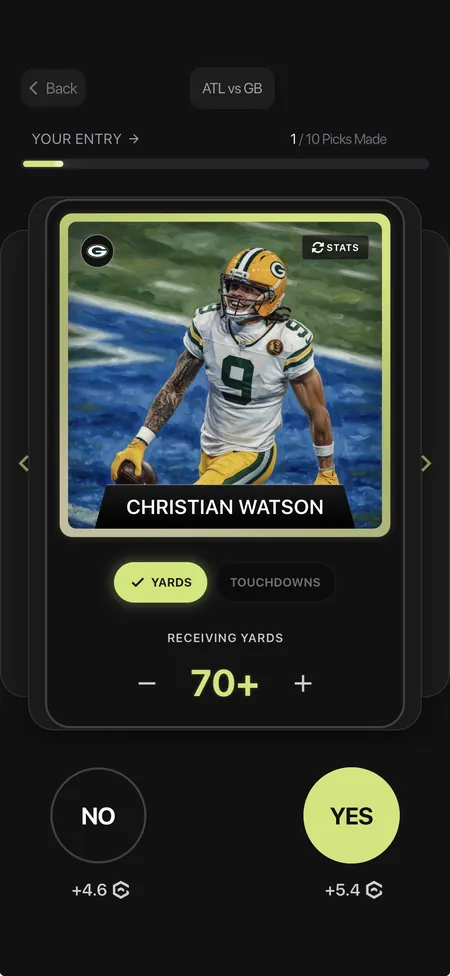
That's a real pick card from GAGE. YES on Christian Watson reaching 70 receiving yards shows +5.4, which means the odds give it a 46% chance: land it and you score +5.4, miss it and you lose 4.6.
Say you've read his week and you like YES. His snaps have been steady, and news before the game points more targets his way, so you lock YES at 46%. By kickoff the odds have caught up to 55%, and your pick keeps its 46%.
Now it's the third quarter, Watson has 61 yards, and the app shows his chance of reaching 70 at 74%. Your pick is still worth +5.4 if he gets there, and the 74% moves your place on your leaderboard. The full scoring and lock rules are on the odds page, and GAGE is on the App Store if you want to make this pick on a real game.