
The best way to watch sports with friends is to be playing against them on the game you're watching. You each make your picks before it starts, and a leaderboard ranks you as it plays out. Every pick is worth points based on its chance of landing, so a routine catch on third down suddenly matters to somebody in your group.
Here's how one game runs in GAGE, start to finish.
| When | What happens |
|---|---|
| Before the game | You invite up to nine friends into your group (the app calls it a lobby). Everyone gets the same options. |
| When you make a pick | The odds you got lock to that pick. |
| Until the game starts | You can change picks. A changed pick takes the odds at that moment. |
| At the start | Every pick locks for good. |
| During the game | Each pick shows its live chance of landing, and your place on the leaderboard moves with it. |
| At the end | Every pick is scored, and the leaderboard ranks your group. |
Everyone in your group gets the same options
The options are a menu of picks, each one a player or team outcome with a line, like "Receiving yards 70+" or a pitcher's strikeouts. You pick YES or NO. In Team Pick'em, a GAGE mode, the picks are team outcomes and totals across a slate of games.
Nobody gets a better menu than anyone else, so what separates you from your friends is the picks you make and when you make them.
That menu is also what keeps the whole game worth watching. A contest on the final score has one result that matters, and it usually isn't settled until late. A group full of player picks has something to follow on almost every drive, since a single catch can move somebody's pick.
Your odds are your own
The odds on every pick keep moving until the game starts, and each pick locks the odds you got when you made it. Your friend can make the exact same pick an hour after you and get a different chance, which means different points.
Here's a real card: Christian Watson, receiving yards 70+, with YES worth 5.4 points and NO worth 4.6. Those points put YES at a 46% chance.
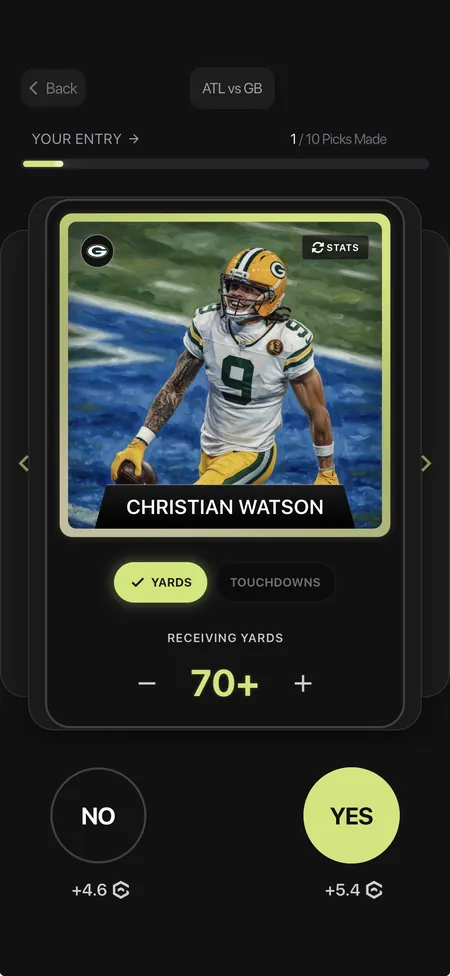
Say you take YES on a pick like that at 46%. NFL teams turn in their inactive lists about 90 minutes before kickoff (NFL Football Operations), and this time the team's other starting receiver is on it. The chance on your receiver's 70+ climbs to 60%. A friend who takes YES now gets +4.0 if it lands and −6.0 if it misses. Your YES still scores +5.4 or costs 4.6.
Wait for the inactive list and you'll know more, and so will the odds. Locking early is its own kind of read, because you're making the pick before the news is out. A pick you leave alone keeps the odds from when you first locked it. Change its side or line, or drop it and add it back, and it takes the odds at that moment. The odds page has the full rules.
The best picks are the ones you'd argue about
The simplest homemade contest gives one point for every right answer. That rewards whoever takes the favorite on everything, since favorites land more often. If one friend picks a 70% favorite and another picks the 30% underdog, a right answer is worth the same point to both of them.
GAGE weights each pick by its chance instead. The 70% pick scores 3 if it lands and costs 7 if it misses, and the 30% pick scores 7 or costs 3. Take every favorite and you'll finish around zero, because picking everything the way the odds do averages zero.
So the picks that split a group are the ones where you and your friends see the chance differently. If you think that receiver gets to 70 yards more often than the card's 46%, YES is your pick. If your friend thinks the card has it about right, they'll put their picks somewhere else, and the leaderboard will show which of you read the game better. The post on favorites and underdogs covers how to read those percentages.
Friends who half follow the game can still play
Not everyone in your group tracks snap counts. That's fine, because every card shows what each side is worth before you pick, and the points tell you the chance. A side worth 7 if it lands has a 30% chance, and a side worth 3 has a 70% chance.
A friend who only watches the big games can look at a 30% pick and decide whether they believe in it, knowing exactly what it costs if they're wrong. They're playing the same game you are, with the same options, and the leaderboard scores their picks exactly the way it scores yours.
Every play moves the leaderboard
Once the game starts, each pick shows its live chance of landing, and your place on the leaderboard moves with it. Say it's third and six, your receiver's at 61 yards, and his chance of hitting 70 just jumped to 74%. Your friend who took NO on the same receiver just watched their own chance fall to 26%.
The plays in the middle of the game move your chances, so the final score stops being the only thing you watch for. Say you took YES on a pitcher's strikeouts line at 45%, worth +5.5 if he gets there. With two outs in the sixth he's one strikeout short, and every two-strike count moves your chance. The guide to watching a baseball game by the numbers covers what to track pitch by pitch.
Each game gets its own group
There's no season-long roster to manage and no bad month dragging you down, because each game stands on its own and the next one starts fresh. You can start a group for whatever game you're watching, and the friends you invite can change from one game to the next.
Timing matters, because picks lock for good when the game starts. A friend who shows up after kickoff has missed the chance to make picks on that game, so get your group set before it begins. Team Pick'em follows the same rule across a slate: every pick locks at the slate's first kickoff.
The leaderboard shows who read the game best
When the game ends, every pick is scored, and your score works out to 10 × (picks right − the number of picks the odds expected you to get right). The leaderboard ranks you against your group. Here's how a group of four might finish:
| Player | Picks right | Odds expected | Score |
|---|---|---|---|
| You | 5 of 10 | 4.2 | +8.0 |
| Maya | 4 of 10 | 3.5 | +5.0 |
| Chris | 7 of 10 | 7.1 | −1.0 |
| Dev | 3 of 10 | 4.4 | −14.0 |
The odds-expected column adds up the chances each player locked. Chris's picks averaged a 71% chance, so the odds expected about seven of them to land. Chris landed seven, the most in the group, and finished third. You got five right when the odds expected 4.2, and that's first place.
Get GAGE on the App Store and invite up to nine friends to your next game. How a game with friends works covers the rest, and if you want your own reads to hold up better, start with the habits that make your picks better.